Why Sumi Isn’t Just “For Japanese Stuff”
What modern tattooers can learn from an ancient material
The Mystery of Sumi
For the first seven or eight years of my tattoo career, Sumi was just this word that I heard. With my self-taught foray into tattooing, I was constantly using the internet to find whatever information I could.
There was Kiro Sumi- like the cheapest black that you could buy and it would heal pretty dark too! At least it had “Sumi” in the name, right? Then I remembered back to the time in my childhood when my family lived in China. They’d sell kits that had: a calligraphy brush, a cast iron plate for grinding, and what I now know was a Sumi stick called a “mò” (墨). I got one of these at 11 years old just to try my hand at Chinese Calligraphy. It probably goes without saying that I didn’t get very far!
And then lastly, I’m sure many of you will remember this guy from YouTube named “Johnny Gault”. When I was starting out tattooing it’s funny because this was like “the dude” for me to learn from 15 years ago. In hindsight, of course, this dude was teaching way above his paygrade- not to mention making YouTube videos about it. However, I still liked to watch his stuff.
Johnny Gault had this one video that compared different black inks I believe (He ended up declaring that Dynamic was the blackest back then), but when it came to talk of Sumi black he summed it all up with “it’s for Japanese and stuff like that”.
Believe it or not, that offhand comment/declaration almost made me mad. Like, dude of course it’s for Japanese- the name is Japanese. But why? What makes it suitable for wind bars but not for an Al Pacino portrait? I doubted that this dude actually had the answers but he likely just wanted to address it since Kiro Sumi was quite popular back then.
Then I worked with different guys over the years that showed me how Japanese Tattooing works a bit. I started with just doing pages of finger waves with different flows over and over, then I learned how to draw Cherry blossoms and started doing compositions with just those two elements and so on. I studied the way that many Japanese backgrounds flowed in similar patterns on the arm/leg no matter who was making the sleeve. Then it came time to actually tattoo a Japanese sleeve!
Now this Johnny Gault video came drifting back to me “Sumi is for Japanese and stuff like that”. Does anyone really expect you to scrub 2-drop grey wash with a 15 mag into these clouds and windbars over and over? Sounds too slow. Sounds too inefficient. The background would look so red then (not that it’d be a bad thing) and I don’t really remember seeing many photos of fresh Japanese background that’s all red like that. It tends to look pretty chill in the fresh photos from the Masters.
All of these questions and thoughts caused me to take a proper look at Sumi once again.
Sumi Is Built Different
So if you buy some proper Sumi (we’ll discuss what that is a bit later), you’ll quickly find out that it has a bunch of unique properties when you put it alongside a classic greywash.
For one, it goes dark- like super duper dark. It looks pretty crazy if you aren’t used to seeing it. You have to “tattoo it for the future” not for today. If you tattoo it to have the values look right for today, it’ll likely heal lighter than you’re hoping for. With the proportions in which I mix my own Sumi washes, my “Dark” wash looks basically like black when it’s fresh and continues to age until it finds its true value a few months later. We’ll also talk about why this could be later in this article.
Sumi also has more body than a typical black or grey wash. This can be its greatest asset if one understands how to leverage it.
Lastly, it can come in the form of a solid Sumi stick which is a real trip to see it being done.
My friend Dom has a lot of really cool workflow videos on Instagram where he grinds his Sumi daily from a stick. With his permission, here’s a link to one of these videos he has posted on Instagram:
https://www.instagram.com/reel/DG99rzPxhtO/
What Is The Difference Between Traditional Sumi and Modern Tattoo Black?
First off, “Sumi” (墨) is a Japanese word simply meaning “ink”.
Traditional Sumi was developed for application with a brush such as painting and calligraphy. Historically, it was made by collecting soot from burning oils or pine wood, then combining that soot with a binder known as nikawa, a type of animal glue (aka not vegan). The resulting mixture was pressed into solid ink sticks which artists would grind against an ink stone and mix with water as needed.
Here’s a very accessible video that I’ve watched a few times that goes into more detail on how it’s traditionally made. Super interesting and informative. It really helped me to see it rather than try to imagine the process. It’s crazy involved and elegant.
https://www.youtube.com/watch?v=GSuFSYY-X9w
Modern tattoo blacks, on the other hand, were developed specifically for implantation into human skin. It’s one of those things where they didn’t actually just slap the word “tattoo” on something that already existed.
While the exact formulas vary from manufacturer to manufacturer, most modern black tattoo inks rely on highly refined carbon black pigments suspended in a carrier solution designed to promote consistency, flow, & stability. The process is also much more careful when it comes to sanitation.
So, both traditional Sumi and modern tattoo blacks are carbon-based. Got it! The difference typically lies less in the pigment itself and more in how that pigment is processed.
To make matters even more confusing, many products sold today under the name "Sumi" are not traditional Sumi at all. Some are bottled calligraphy inks, while others are fully modern tattoo pigments manufactured using contemporary methods (Kiro Sumi is an example of this). As a result, two products labeled "Sumi" sometimes share very little beyond their name (and some Kanji on the label).
For that reason, it is often more useful to think of Sumi not as a single product, but as a category of related carbon-based inks that trace their roots back to traditional East Asian ink making. AKA don’t necessarily just trust the word “sumi” if it’s labeled for tattooing specifically.
As I just mentioned, today the word "Sumi" is used much more broadly. Depending on the context, a tattooer might be referring to:
Traditional ink stick Sumi
Bottled liquid Sumi (intended for calligraphy)
Modern tattoo inks marketed as Sumi
This distinction matters because many of the observations tattooers make about Sumi- its tendency to appear darker when fresh, heal softer, and/or with a bluish cast- may depend heavily on which type of Sumi is being discussed. So, just something to keep in your back pocket when experimenting/testing stuff.
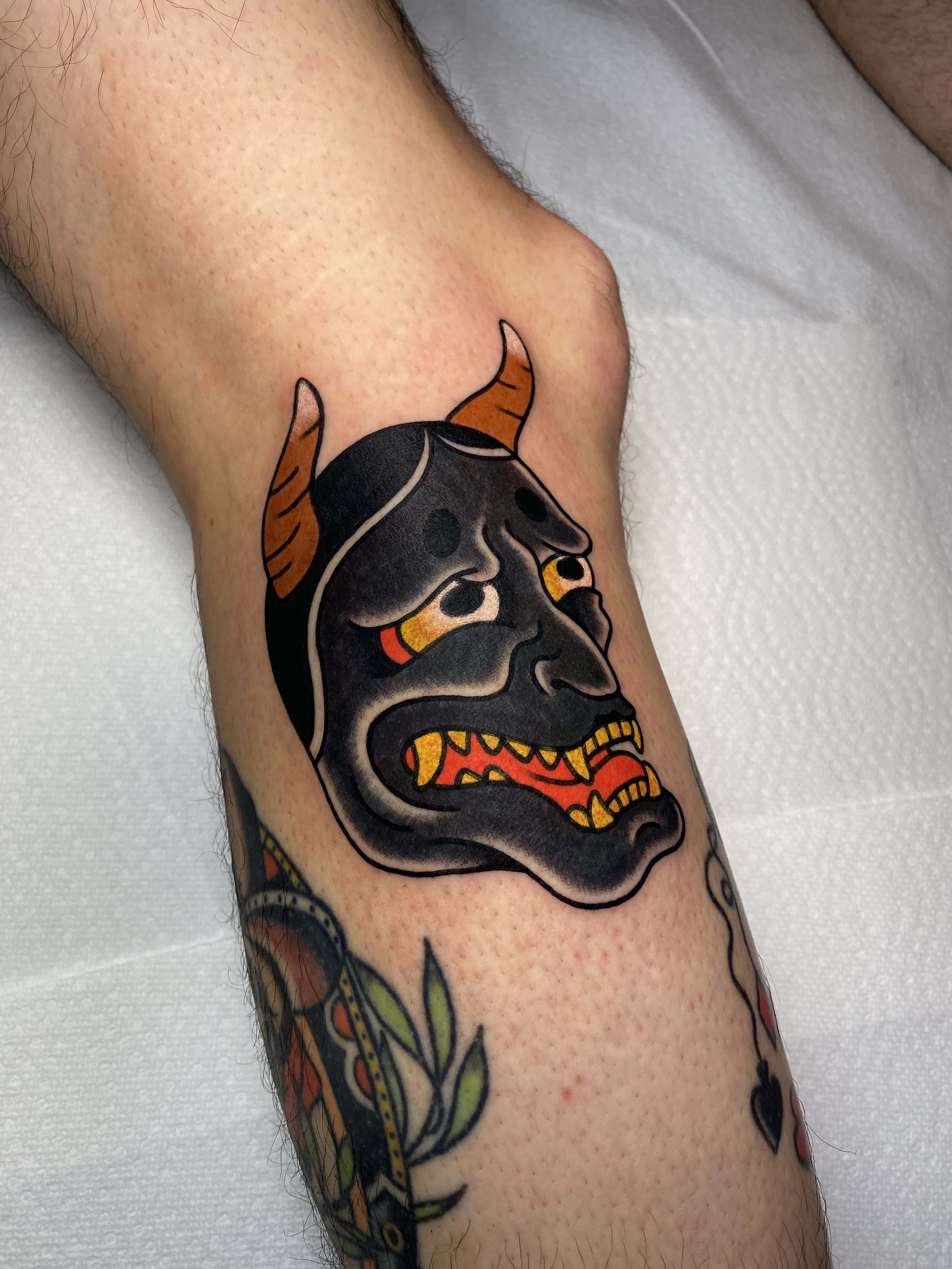
Fresh Sumi
Why Did/Do Japanese Tattooers Prepare Sumi Fresh?
One of the most recognizable traditions associated with Japanese tattooing is the practice of preparing Sumi fresh each day. To many modern tattooers, this can seem unnecessary. After all, we live in a world of sanitary, user-friendly, premade tattoo inks that can sit on a shelf for years.
Historically however, tattooers didn't have access to those products.
As previously mentioned, Traditional Sumi was commonly stored as a dry ink stick made from soot and a binder such as nikawa (animal glue). When the artist was ready to work, the ink stick would be rubbed against a slightly wetted ink stone in a circular motion, creating a liquid black ink that could then be used for various mediums including tattooing.
This process actually offers several practical advantages.
First, dry ink sticks store exceptionally well. Because the material is kept dry until use, there is little concern about spoilage, separation, or contamination.
Second, the artist has complete control over concentration. By adjusting the amount of water and the amount of grinding, it is possible to create inks that range from rich black to lighter washes slowly and carefully.
Finally, (and perhaps most importantly) preparing Sumi has become part of the artistic ritual itself. If you haven’t watched Dom’s video linked above yet- check it out! The ritual is very admirable.
Similar to sharpening a pencil or tuning a musical instrument- grinding Sumi is viewed as an important part of the Japanese Tattooing process. The preparation helped the artist establish consistency, focus, and control before beginning work.
It reminds me of the Documentary “Jiro Dreams of Sushi” where the apprentice has only been working on the egg custard-type Tamago sushi for years before he can handle the fish. Being able to create a consistent product is a core tenet of tattooing too, wouldn’t you say?
Today, some traditional Japanese tattooers continue this practice, while others use modern pre-bottled inks. In many cases, the daily preparation persists not because it is strictly necessary, but because it maintains a connection to the historical methods that shaped the art form.
If Sumi and Tattoo Black Are Both Carbon-Based, Why Does Sumi Seem to Go In Darker and Heal Lighter?
You’ve likely heard the same observation repeated again and again: "Sumi goes in incredibly dark and heals incredibly light”.
At first glance, this seems contradictory. How can a pigment appear darker during application yet heal lighter several weeks later?
The answer is likely more complicated than simply saying that Sumi is "stronger" or "weaker" than traditional tattoo black.
First off, a fresh tattoo is not an accurate representation of the final healed result. Immediately after tattooing, the skin contains a mixture of pigment, carrier solution, blood, and inflammation. All of these factors contribute to the appearance of the tattoo. Nearly every black ink on the market will appear darker when freshly applied than it will after healing anyway.
However, many artists feel that this shift is more pronounced when working with Sumi.
One possible explanation is particle size.
Historically, Sumi was prized for producing exceptionally smooth blacks and great transitions. But keep in mind that this is a handmade process and less uniform. Finely divided carbon particles can create tremendous “optical density” when suspended in liquid, producing a rich, almost velvety black appearance. Once healed beneath the skin, however, that same softness can sometimes translate into a less dense appearance than a heavily concentrated modern black.
Let me explain this in a less technical way: tiny particles stack or “layer” very well to the eye when fresh. This creates a strong “depth of darkness” when fresh. However, at the end of the day, they’re still remarkably small particles- smaller than a typical modern tattoo black. As I’ve talked about before,usually the smaller the pigment particle- the faster the fading/aging of a pigment. The super small particles (which can make up an impressive portion of the Sumi itself) can get flushed-out and detoxed almost before your eyes.
It is for this same reason that we typically see blowouts with black and not color- smaller particles can “leak” a bit more than larger ones and the carbon particles in both Sumi and black tattoo ink are both smaller typically.
Pigment concentration may also play a role. Obviously, not all Sumi products are created equally. Some are extremely concentrated, while others are formulated specifically to create smooth washes and soft gradients and are designed to “spread-out” quickly.
There is also the question of intended use. Modern tattoo blacks, by contrast, are often engineered specifically for saturation and long-term stability and are simply made in a different way. (How and why this is will be a different article in the future)
Keep in mind that this does not mean that Sumi is inferior. In fact, many of its strengths stem from these very characteristics. The same qualities that can produce softer healed blacks can also contribute to exceptionally smooth backgrounds, atmospheric effects, and subtle gradations.
For this reason, many modern Hori (tattooers) reserve pure Sumi for areas where softness and transition are desirable while incorporating more concentrated tattoo blacks when maximum healed density is required.
To give myself some grace here and the limitations of online research- keep in mind that many of these observations are widely reported by artists, but separating the effects of pigment, formulation, technique, and healing variables is often difficult.
Whatever the exact mechanism, many experienced Japanese-style tattooers have arrived at a similar practical conclusion: pure Sumi excels at softness, atmosphere, and smooth value transitions, but may not always be the ideal choice when maximum healed black density is the goal.
This is one reason some artists choose to reinforce their washes with a small amount of concentrated tattoo black. By combining the smoothness associated with Sumi and the density associated with modern tattoo pigments, they hope to achieve the best of both worlds.
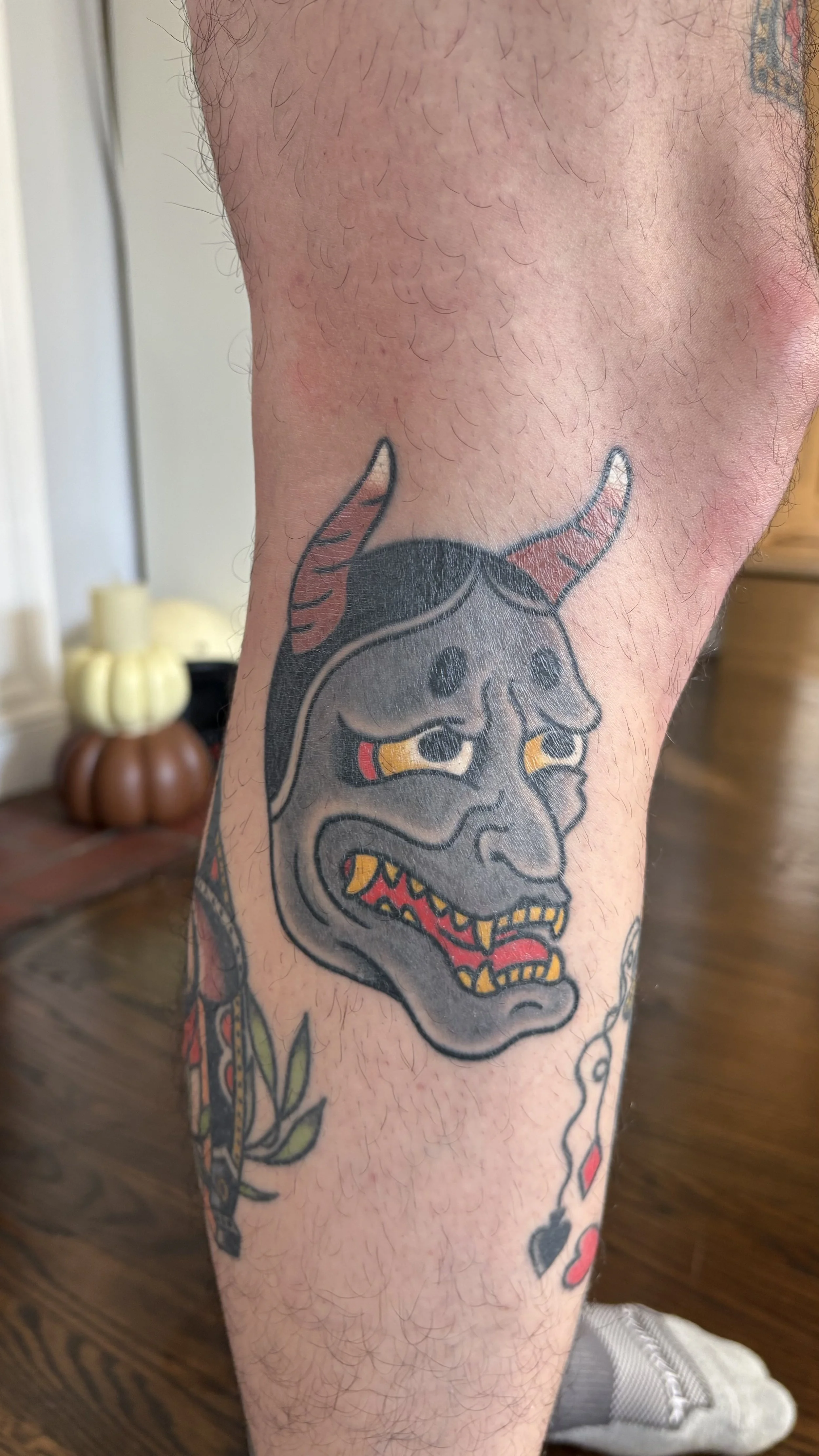
One Month Old
Why Does Sumi Sometimes Heal Blue?
Another characteristic frequently associated with Sumi is its tendency to heal with a bluish cast. While not every Sumi product behaves this way, many tattooers have noticed that healed work often exhibits a softer blue-black appearance when compared to the warmer or more neutral blacks (& greys) commonly seen in modern greywash.
As with many aspects of tattooing, the explanation is probably more complex than a single ingredient or manufacturing process. I can’t say definitively one reason but here’s likely what’s going on: PIGMENT DENSITY.
As a black tattoo becomes less saturated (aging Sumi), subtle undertones that were previously hidden can become easier to perceive. A heavily-packed black area tends to absorb light uniformly, appearing deep and neutral. As that density decreases, however, the way light interacts with the pigment beneath the skin becomes more noticeable.
The skin itself also plays a role. Tattoo pigment is not viewed directly. Instead, we see it through a translucent layer of living tissue via different angles. Light enters the skin, scatters, interacts with the pigment, and then returns to the eye. It’s the same concept as glare and/or polarization. This process can alter the way colors are perceived and may contribute to the cool blue appearance often associated with softer carbon blacks.
It is also worth acknowledging that many of the classic Japanese tattoos that shaped our perception of Sumi are decades old- just like Bob Shaw tattoos still out there in the wild. Many people describe these as also having a ‘Green’ or ‘Blue’ appearance.
Whatever the cause, the blue-black quality of Sumi is, to me, a feature rather than a flaw. In the context of Japanese tattooing, that softer cooler appearance can enhance atmospheric elements such as: wind bars, finger waves, and clouds- particularly when contrasting with high Saturation colors typically used in Japanese Tattooing such as: Persimmon, Phthalo Green, Phthalo Blue, and Gold. It even makes well-packed Titanium White contrast better from the greyscale background.
When is Sumi Better Than Black?
By this point, it should be apparent that Sumi is not simply a darker version of traditional greywash It is a material with its own strengths, weaknesses, and aesthetic qualities.
Understanding those qualities can help an artist decide where Sumi may be advantageous and where another black might be a better fit.
Perhaps Sumi's greatest strength is its ability to create smooth transitions. Many tattooers are drawn to the way it handles large areas of shading. Heavy greyscale backgrounds often benefit from the softer character that Sumi can provide and its tendency toward a bluish healed result can help it contrast with bright colors in the foregrounds- particularly (theoretically) if the foreground features mostly warm colors.
When a sleeve or backpiece contains extensive areas of background shading, an overly-dense black can sometimes compete with the primary subject matter. A softer black can allow the foreground imagery to remain dominant while still providing structure, contrast, and visual depth.
It can be great for grey lining as well.
Simply put, it can be beneficial to let your blacks be VELVETY BLACK and your greys be more soft creating even more depth. If you take a look at the Japanese Masters’ work- this effect becomes really obvious. As with any tattoo- contrast is your friend.
If you’re going for a blackout sleeve, tribal, or geometric stuff that relies on absolute visual density, a more concentrated modern tattoo black is likely a better choice.
This does not make one material superior to the other. It simply highlights an important principle that applies to every aspect of tattooing: different tools are designed to solve different problems.
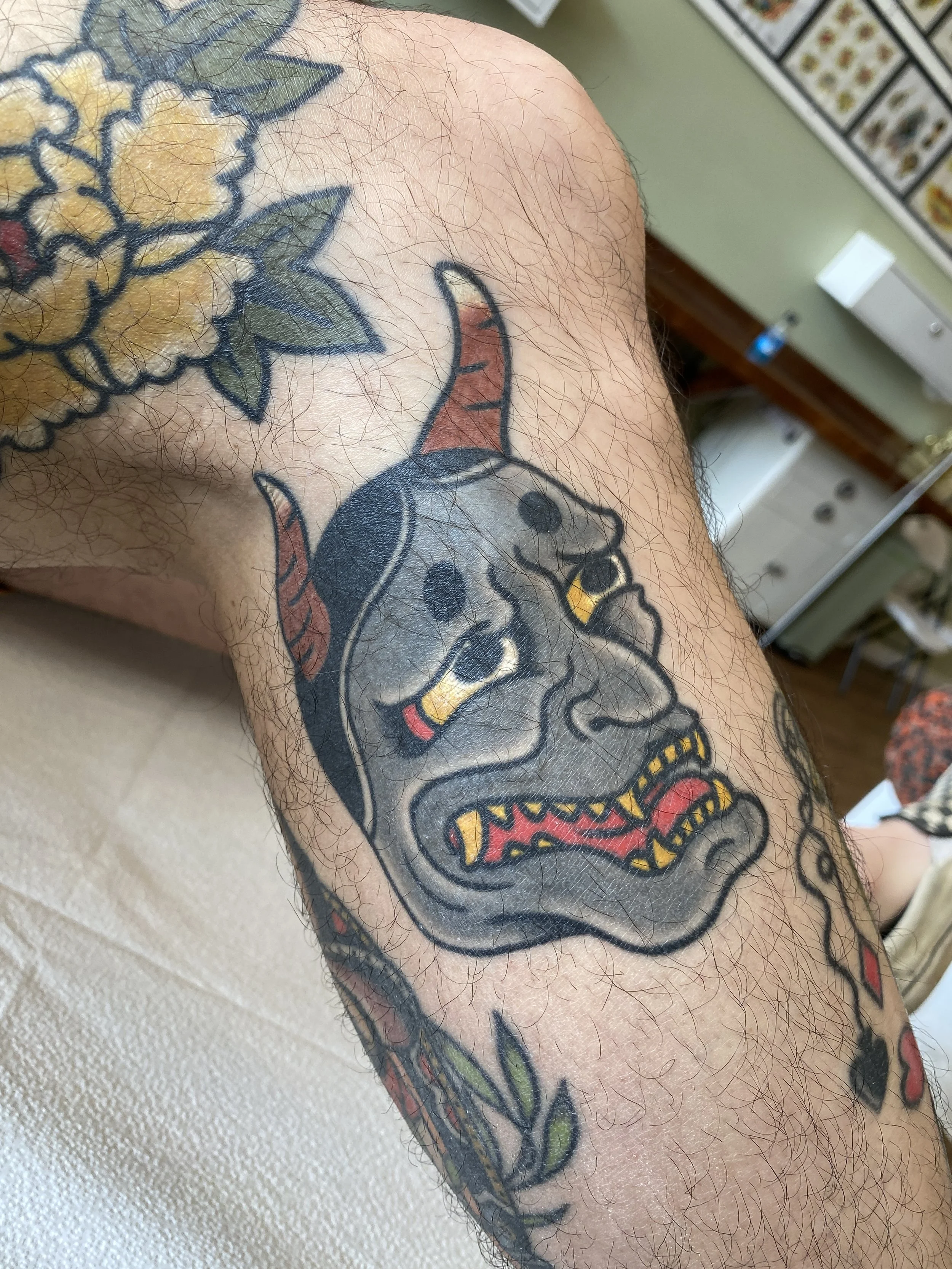
6 Months Healed
Practical Tips For Working With Sumi:
You might be saying, "Interesting stuff, but how do I actually begin to incorporate Sumi into my work?"
Well, here are some things to experiment and play with. Since I’m a nerd, I highly recommend tracking everything in a notebook or labeling your bottles with the exact concentration of the recipe (for example: 4 oz Allegory Blak, 4 oz Liquid Sumi, 1 oz Witch Hazel).
Also, if you’re going to try pre-made washes, just like mixing your own pigments, sanitize everything well with 91% isopropyl alcohol or something stronger.
Then when you use this formula on a piece, keep track of it. When did you tattoo it? Which wash did you use on which part? How does it look now 2 months later?
As you probably figured, try larger curved mags for greater consistency over large areas of grey.
Also, I go on and off with textured mags. In my experience, the additional texture slows things down a little bit but gets better, more-consistent heals with better results using curved mags rather than flats.
Remember: Sumi has more body (due to the nikawa) than a typical bottled greywash so it wants to be treated more like a color than a 1-drop grey.
Practical Tip: Try Adding Regular Tattoo Blacks
One of the more common practices today is the addition of a small amount of concentrated tattoo black to Sumi washes.
The reasoning is fairly straightforward.
Many artists appreciate the smooth transitions and softer healing qualities associated with Sumi, but may find that pure Sumi lacks the long-term density they are looking for in certain applications. By introducing a small amount of concentrated tattoo black into the mixture, they can often increase healed contrast without completely sacrificing the character that attracted them to Sumi in the first place.
The exact ratios vary widely from artist to artist. Experiment yourself and track everything!
Maybe a good first experiment would be to tattoo a wash with straight liquid Sumi just to truly witness how incredible it ages in the skin over a few months. It won’t be nearly as dark as, say, a Royal Talens or a Dynamic black.
Practical Tip: Mixing-Down Sumi
Historically, Sumi was diluted with water.
Many modern tattooers continue to keep things relatively simple.
Common dilution solutions include:
Distilled water
Witch hazel
Commercial wash solutions (For example: Dynamic Ink Mixing Solution)
I recommend Witch Hazel. It contains alcohol, is antiseptic, and calms inflammation. You can’t say that for water. You still have to keep an eye on it though! You could mix smaller bottles at a time too so that you run through it faster (thereby reducing spoilage).
And Where Can You Get It?
Today, tattooers generally encounter Sumi in one of three forms:
Traditional ink sticks
Bottled liquid art Sumi
Tattoo-specific Sumi products
Traditional ink sticks are perhaps the closest connection to historical Japanese tattooing. They require an ink stone and must be ground fresh with water before use. While relatively uncommon in modern tattooing, some traditional artists still prefer this method. It’s so cool but I wouldn’t know where to start with it. I’d seek out help and mentorship from someone that already does this.
Bottled liquid Sumi is readily available through art suppliers and calligraphy retailers. Products from companies such as Yasutomo and Boku-Undo are popular among artists and calligraphers. These products vary considerably in formulation and may contain different binders, preservatives, or additives. Also, it’s really hard to know whether a product is vegan-friendly or not. Sometimes the glue is animal-based, sometimes vegetable-based. Do your research. Send the company an email. Give them a phone call. Be an adult.
Finally, many tattoo suppliers offer tattoo-specific Sumi products that are manufactured and sanitized specifically for tattooing. Again, no guarantee on what is in these formulations exactly. Most of these ink companies are extremely secretive and don’t really share their processes.
Don't Get Lost Chasing The Perfect Black
Perhaps the most important takeaway from this entire discussion is that Sumi is simply a tool.
Over the years, countless debates have centered around which black is darker, smoother, richer, or more traditional. Just like the Johnny Gault video that I mentioned. While those discussions can be interesting, they sometimes distract from the factors that matter most.
The best black in the world cannot compensate for poor tattooing or the lack of wisdom of when to use it or not.
Whether you prefer traditional Sumi or modern tattoo blacks, the goal remains the same: placing the right value in the right place to create a tattoo that will look right forever.
With much love and sincerity,
Jordan Brill (The Upgraded Tattooer)